

How local banking habits create different casino categories across Europe
People typically speak about Europe's online casino market as a single, oversized industry. Same continent, same games; however, logging in from Finland or France can feel like two radically different products.
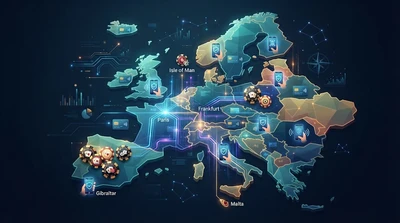
Banking infrastructure, payment preferences, and identity verification requirements drive operators to build formats for individual markets, and those choices shape how you access a game, deposit, and withdraw.
Once you see it this way, comparing game libraries and bonus offers conveys far less than comparing underneath the hood.
Local banking habits seldom grow in isolation, with national payment networks and long-standing relationships with banks setting expectations for anything people do online, casinos included. A method that feels entirely ordinary in Finland can look exotic to someone in France paying with a card or a wallet app.
The European Central Bank's 2024 payment study found electronic payment solutions were behind 76% of online payments in the Netherlands, compared with 29% for the euro area as a whole. That aperture is sizeable, with operators built around it, as payment friction lands on your playing session. It also illustrates why European casino categories track financial culture as closely as gaming preferences.
Finland's bank-authenticated casino category
Finland provides a pertinent example, where casinos built around bank authentication are commonly grouped under the local pikakasino category, which has no precise English equivalent. Finnish specialist pikakasinot.com provides a local reference point for this market.
It supports international readers in distinguishing an established product category from the overly broad translation "fast casino." Its coverage focuses on casinos where bank credentials connect identity verification, account creation and payment into a streamlined process.
People sometimes describe a pikakasino as a regular casino with quicker withdrawals, but the difference runs deeper. What defines the category is bank authentication built into the initial step, so you identify yourself through a supported banking service and never fill in a conventional registration form.
Trustly's Pay N Play does exactly that, integrating account creation, identity verification and an initial deposit into a single transaction, providing much of the appeal for Finnish players.
It is worthwhile pairing that category with the legislation behind it. Veikkaus keeps exclusive gambling rights in mainland Finland until the end of June 2027, with a licensed market scheduled to open in July 2027.
So, when you compare Finnish platforms, check the license as carefully as the login, since bank-authenticated sign-up does not mean an operator has permission to target Finnish customers.
Sweden and the rise of account-linked casino experiences
Sweden built a related category around BankID, the country's widely used electronic identification system. Its significance goes beyond payments, because it gives people a familiar way to prove who they are online.
Casino operators can build registration and account access on top of that existing banking relationship. That setup helped Pay N Play find an audience among Nordic players already using digital banking credentials for everyday transactions.
Swish handles a different job, where the mobile service moves money between participating bank accounts, with that remaining separate from proving who you are, even when one interface makes both feel seamless. Compare Swedish platforms with that split in mind, since verification and moving funds remain distinct processes behind the screen.
The Netherlands and Poland: familiar payment networks
The Netherlands discovered another route, with Dutch consumers having leaned on iDEAL for years. As it is bank-connected, shoppers confirm each payment through their financial institution, ultimately making it the default for digital commerce.
However, the ground is shifting: the move from iDEAL to Wero began in 2026 and is targeted for completion by the end of 2027, so cashier pages will follow wherever Dutch payments head next.
Poland shows a local system becoming the obvious pick, with BLIK operating inside participating banking apps. In December 2025, the Polish Economic Institute reported that 56% of online shoppers preferred BLIK for their purchases.
The number comes from general e-commerce rather than gambling, but it shows how firmly a domestic habit can set in. It is also why operators entering Poland reach for the familiar option first.
Western Europe: cards, wallets and different expectations
Western Europe reveals why one format cannot cover the entire continent. Great Britain's Gambling Commission banned credit card gambling in April 2020, with the prohibition covering online casinos alongside other gambling products.
Operators also must stem customers routing around the ban with e-wallets funded by credit cards, with the result a payment mix where debit cards, bank transfers and independently funded digital wallets each hold their own position.
Germany, France and Italy unite them differently once more, with digital wallets sitting strongly alongside traditional bank transfers and cards. The Malta Gaming Authority's report for January to June 2025 adds another angle: among its licensed operators, cards accounted for 42.7% of online deposits, bank transfers 33.8% and e-wallets or online accounts 17.7%.
Those figures pool the wider licensed operator group, so read them as a standard beyond a simple country-by-country breakdown.
Why local banking habits matter to the wider industry
None of this stops at the cashier screen, as payment infrastructure influences account verification, transaction processing and how withdrawals get paid out. European payment regulations do set shared requirements, strong customer authentication among them, generally calling for two or more independent authentication elements.
Shared rules still leave plenty of national variation in banking services and consumer expectations, so operators need to learn the financial habits of every market they enter.
If you have been playing for some time, these categories give you a sharper way to read Europe's casino industry. A Finnish pikakasino, a Swedish account-linked casino and a conventional card-funded platform are three different answers to the same question about customer access and financial transactions.
None automatically offers more pleasing games, more promising odds or more substantial player protection, because those qualities depend on the individual operator, its licensing arrangements and its game providers.
Europe's casino terminology ends up as a map of local banking habits, with those habits continuing to generate distinct commercial categories across a market that grows more connected every year.
