

How to Review a Poker Hand Before Revealing the Result
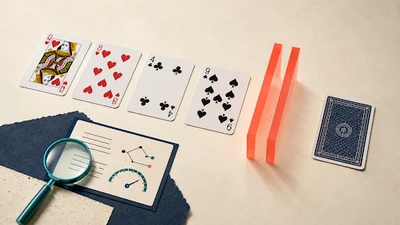
A river card can make an earlier poker choice look obvious. Once the full board and final result are visible, it becomes difficult to remember how uncertain the decision felt. A reliable review starts by hiding what happened next. Reconstruct the choice from the information available at that moment, record the reasoning, and reveal the remaining action afterwards. This keeps the quality of the decision separate from the clarity supplied by hindsight.
A 2025 replication of research into hindsight bias, using estimates of sugar content in familiar foods, found that relevant new information can update a person's knowledge and change a later reconstruction of an earlier judgement. The experiments did not involve poker, and the researchers noted that other mental processes may also contribute, but it still demonstrates a clear point: simply trying to remember an original judgment after seeing the outcome may produce a fresh judgment built from different information. A first-pass record avoids relying on that reconstruction.
First Pass: Preserve the Original Choice
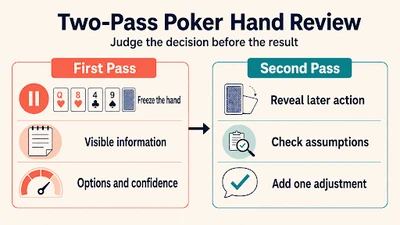
A strong first pass begins with one marked decision rather than the session. Stop the hand immediately before the choice and hide every later card and action. If the history cannot be concealed on screen, copy only the preceding action into a blank note. In online poker for real money, position, betting order, effective stack, the smaller stack in play, and pot size shape each choice while the remaining cards are unknown. Record the action so far, list the reasonable options, and give the original choice a one-sentence reason.
Add a confidence score before revealing anything else. Later cards can make a plausible fold appear timid, a reasonable call appear careless, or an ambitious raise appear inevitable. Those labels belong to the finished story. Include timing or opponent behaviour only if it was noticed during play; observations added afterwards belong in the second pass. When the hand is reopened, the note prevents a later card from being mistaken for information available during play.
Short hand examples with delayed explanations can create the same conditions. In this video on 10 poker hands that players often overplay, pause as soon as each situation appears, before the narrator gives an opinion. Note the position, stack information, action already taken, available choices, provisional decision, and confidence. Resume only when that record is complete. Treat the narration as one comparison point rather than a universal ruling. Differences between the two accounts can reveal whether new information changed the judgment, exposed a missing assumption, or merely supplied a more convincing way to describe the same choice.
A compact first-pass record needs five entries:
- Information visible at the decision point
- Genuinely available options
- Expected response to each serious option
- Assumption carrying the most weight
- Confidence before later action is revealed
Rebuild One Decision, Not the Whole Hand
Consider a six-handed hold'em example. The dealer button raises with ace-queen suited and the big blind calls. The flop brings a queen, an eight, and a four with two cards of the same suit. The player bets and is called. A nine comes on the turn. The big blind checks, then raises. Stop before the river, final action, and exposed cards.
The review asks which turn action suited the available information. Record the effective stack, pot size, and raise size. List the plausible made hands, draws, and bluffs supported by the earlier action. Compare folding, calling, and raising against those possibilities. Mark any missing detail as unknown instead of quietly filling it in. A thin margin should not become a confident verdict simply because one option later won the pot.
A conclusion such as “the raise always means strength” ignores player variation. “Top pair is too good to fold” ignores stack depth and raise size. “The draw missed” uses a later card that was unavailable on the turn. Each sentence identifies a different flaw, so the correction can be specific: improve the range estimate, account for bet size, or remove outcome information from the first pass.
Second Pass: Add the Outcome and Feedback
Reveal the remaining action only after the first record is complete. Compare what happened with each assumption, not merely with the action chosen. A bluff does not automatically make the call sound, because the player may have assigned too many bluffs for weak reasons. An opponent's strong hand does not automatically make a fold sound, because the estimate may have excluded realistic bluffs. The result becomes another piece of evidence rather than the score for the decision.
Preserve the original reasoning before asking another player to comment. A 2025 randomised study of 68 final-year medical students compared written reflection alone with reflection followed by individual feedback. After six teaching sessions, the feedback group recorded a mean post-test score of 69.32%, against 51% for the reflection-only group. A hand review can use the same approach: private reasoning first, outside feedback second.
Give a knowledgeable reviewer the concealed hand and the first-pass note, then ask which assumption needs correction. Record one adjustment, such as tracking turn raises by position or writing pot and stack sizes before judging a call. On the next review, check that specific adjustment. You'll soon find your play improves!

Author
Gambling Consultant
