

Romania's Online Gaming Market in 2026: An Authorisation Tax Floor of EUR 480,000
One rate is a poor description of a market.
Romania's online gaming taxes can easily be reduced to one headline rate, even though that figure does not describe the full cost of operating in the market. Underneath it sits a fixed annual minimum, introduced with the fiscal package of August 2025, and that minimum is what shapes the cost of holding an online authorisation. The distinction matters, because the two numbers answer different questions about the same market.
What the 2025 law actually charges for
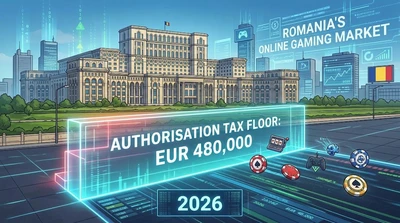
The authorisation tax for online games of chance is 30% of revenues, but not less than EUR 480,000 a year, according to Legea 141/2025. According to the same 2025 law, pariurile cu cote fixe, Romania's fixed-odds category, are taxed at 25% of revenues with a minimum of EUR 240,000. The two are separate activity categories rather than one product priced twice, and on both the rate and the floor, the online authorisation is the more expensive: EUR 240,000 separates the two minimums.
Percentages scale with a business. A floor does not. An operator whose revenue-based charge falls below that figure still owes EUR 480,000, while a higher-revenue operator owes more. Legea 141/2025 sets that minimum on an annual basis. The floor creates a high fixed cost for licensees, making the minimum annual charge an important measure of the cost of operating under the authorisation.
An online authorisation sets the regulatory perimeter for an operator's activity in Romania, and the games played through NetBet casino online sit within that licensed operation. The authorisation charge is based on the holder's revenues, at the rate the 2025 law sets for the category.
Where the charges go
The floor did not arrive on its own. The wider fiscal package, reported in July 2025, included a rise in the standard VAT rate from 19% to 21%, with the measures reported as coming into effect from 1 August. A separate provision reached the individual: Legea 141/2025 amended article 110 of the Codul fiscal, the Romanian tax code, so that income from games of chance is taxed according to the size of the amount won.
The two duties are not the same, because the authorisation tax is owed by the licensee while the article 110 charge is set against what an individual wins. Legal analysis of the package reads the measures as increasing financial pressure on operators and suppliers, with direct effect on prices, prizes and winnings. Taken together, they are the two ends of one package, and neither end is visible in the headline percentage.
Protection is only as good as its administration.
Pricing a market is only part of what a regulator does. The protection side has an administration behind it that decides whether it works in practice. The order setting out the self-exclusion procedure was published in Monitorul Oficial no. 557 of 17 June 2025, and it puts a fixed deadline on an organiser to pass a request on to Romania's gaming regulator, the Oficiul Național pentru Jocuri de Noroc (ONJN). A player who wants to stop lodges a self-exclusion request with the organiser, and under that order the request no longer sits there indefinitely.
The procedure follows a system that had a significant backlog: on taking office in April 2025, the then ONJN president, Vlad-Cristian Soare, found more than 15,000 unclassified and unprocessed requests, alongside an unsecured database. Money in this regime does not all travel in one direction. Order 367/2025, issued by ONJN, sets the framework for the 2026 session of Conștient și liber, "aware and free", a state grant programme funding addiction prevention and treatment projects, carrying EUR 5,000,000 of non-repayable funding (25,416,600 lei) from ONJN's own revenues under OUG 77/2009. A register can exist on paper and still not work, which is the caution an earlier piece here makes about what a rating score does not tell you: a published score is not the same thing as the experience behind it.
Two things a country summary usually leaves out.
The two things worth reading in a national regime are not the rate printed on the front of it. They are the floor underneath, which decides what a presence costs, and the administrative capacity behind the protection figures, which decides whether those figures do anything.
Both have to be traced to the underlying legislation, the official gazette and the legal analysis of how each measure works, which means opening the instrument that carries a figure rather than the summary that quotes it. A country summary that stops at the headline rate has left both out.

Author
Gambling Consultant

